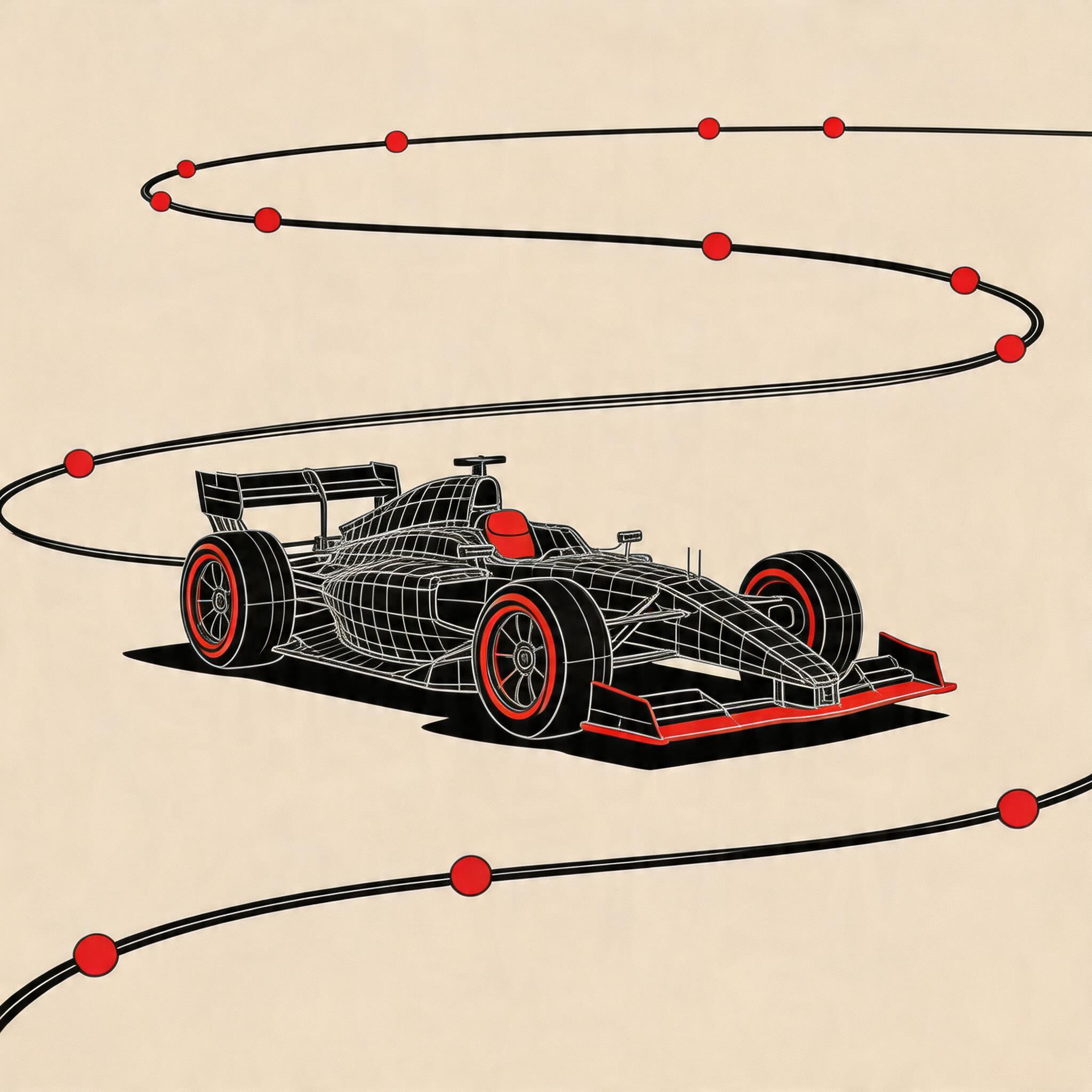
Programming an AI to drive a car perfectly around a track is surprisingly easy. You calculate the optimal racing line, apply maximum efficient acceleration, and execute mathematically perfect braking. The real challenge in game development is programming an AI to drive *imperfectly*—to make mistakes, to show aggression, and to provide an entertaining, human-like challenge without feeling cheap.
Waypoint Navigation and Splines
The foundation of most racing AI is a waypoint system. The track is mapped out with a series of invisible nodes. The AI agent uses vector mathematics to steer toward the next waypoint. However, connecting these points with straight lines results in robotic, jerky movement.
To create smooth driving arcs, developers use spline interpolation (like Bezier curves). The AI doesn't just aim for the next point; it calculates a curved path through multiple upcoming points, allowing it to brake before corners and accelerate out of the apex smoothly.
"Perfect AI is boring. The art is in algorithmic flaws—the moment an NPC misjudges a corner and spins out is the moment it becomes real to the player."
Raycasting and Obstacle Avoidance
To prevent AI cars from blindly following waypoints and crashing into each other, they are equipped with virtual "whiskers." Using raycasting, the AI shoots invisible lines outward from the front and sides of its vehicle. If a ray intersects with another car or a wall, the AI calculates a repulsive force.
State Machines of Aggression
How the AI reacts to these obstacles is governed by Finite State Machines (FSM). An AI might have states like CRUISING, OVERTAKING, DEFENDING, and RECOVERING.
- Defending: If a raycast detects the player approaching quickly from behind, the AI might switch to a defensive state, intentionally moving off the optimal racing line to block the player's path.
- Overtaking: If the AI detects a slow car ahead, it evaluates parallel splines to determine if there is enough track width to execute a pass without collision.
The Controversy of Rubber-Banding
Perhaps the most debated aspect of racing AI is "rubber-banding" (dynamic difficulty adjustment). If the player falls too far behind, the AI cars subtly reduce their top speed. If the player gets too far ahead, the AI gains impossible acceleration to catch up.
While often criticized by hardcore gamers for negating skill, rubber-banding is a necessary evil in casual web games. It ensures that the player is always in the thick of the action. The psychological thrill of a neck-and-neck finish heavily outweighs the desire for absolute simulation fairness. The trick for developers is to hide the rubber-band so effectively that the player believes the close finish was entirely due to their own skill.