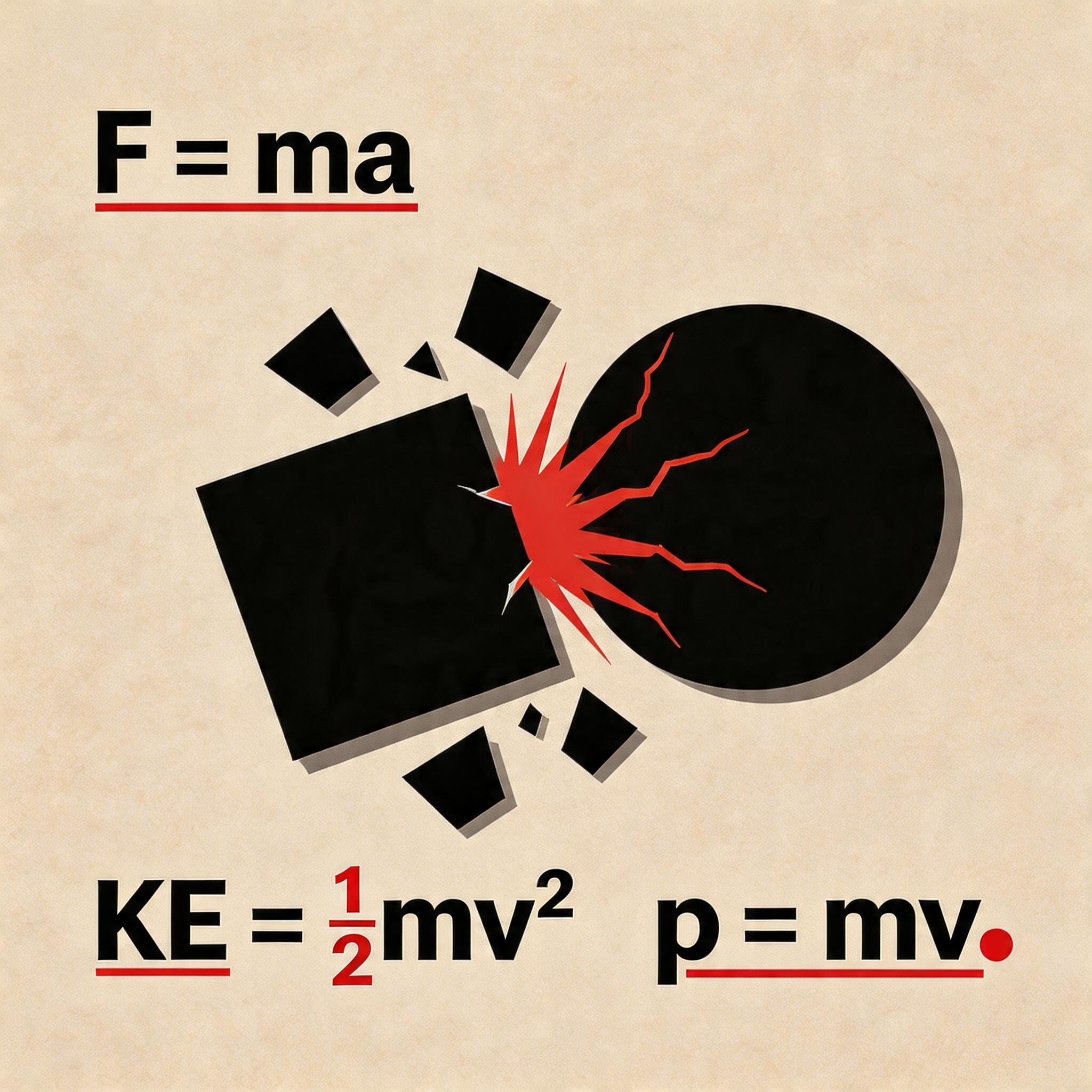
When a digital crate shatters upon hitting the ground, or a character ragdolls down a flight of stairs, we are witnessing a grand illusion. Video game physics are rarely accurate simulations of our universe; rather, they are highly optimized mathematical approximations designed to feel "right" rather than be right. In the realm of web games, where computational resources are shared with the browser UI, decoding these mechanics reveals a masterpiece of algorithmic compromise.
Rigid Body Dynamics and the Box2D Legacy
Most 2D web games rely on rigid body dynamics, a physics paradigm that assumes objects do not deform upon collision. The granddaddy of 2D web physics is Box2D. Originally written in C++, its JavaScript ports (like box2d.js or Matter.js) form the backbone of countless browser games.
Box2D operates on a continuous loop of broad-phase and narrow-phase collision detection. The broad-phase uses bounding boxes (AABBs) to quickly eliminate pairs of objects that are nowhere near each other, saving precious CPU cycles. Only when bounding boxes overlap does the engine perform the computationally expensive narrow-phase calculation to determine the exact point and angle of intersection.
"Game physics is the art of faking reality just enough so the player's brain fills in the rest of the equation." — Erin Catto, Creator of Box2D
The 'Squishy' Feel: Beyond Rigid Bodies
While rigid bodies are efficient, they can feel sterile. Modern web games often employ techniques to add 'juice' to the physics. Soft body dynamics—simulating jelly-like or cloth materials—are traditionally too heavy for casual web games. Instead, developers use clever visual tricks.
Kinematic Faking
When a character lands from a jump, the sprite might squash vertically and stretch horizontally for a few frames. The underlying physics hitbox remains a rigid rectangle, but the visual distortion tricks the eye into perceiving momentum and elasticity. This separation of the logical physics body and the visual rendering is crucial for performant game design.
Determinism vs. Chaos
A major challenge in physics-based web games, especially multiplayer ones, is determinism. If you drop a ball from the exact same height twice, will it bounce to the exact same spot? In floating-point mathematics, the answer is often no. Minor variations in frame rate can cause the physics integration steps to calculate slightly different results.
- Fixed Time Steps: To combat this, robust physics engines use a fixed time step. Instead of advancing the physics simulation based on the fluctuating frame rate, the engine updates at a constant interval (e.g., exactly 60 times a second), ensuring predictable and reproducible results.
- State Rollbacks: In networked games, if the client's physics calculation disagrees with the server, the game must 'rollback' the client's state, leading to the rubber-banding effect familiar to any online gamer.
Ultimately, physics in games is about authoring satisfying interactions. Gravity is tweaked to make jumps floatier; friction is adjusted to make drifting around corners exhilarating. It is mathematics subservient to joy. When you fling a virtual bird at a stack of wooden blocks, you aren't engaging with Isaac Newton; you are engaging with a highly curated playground of predictable chaos.