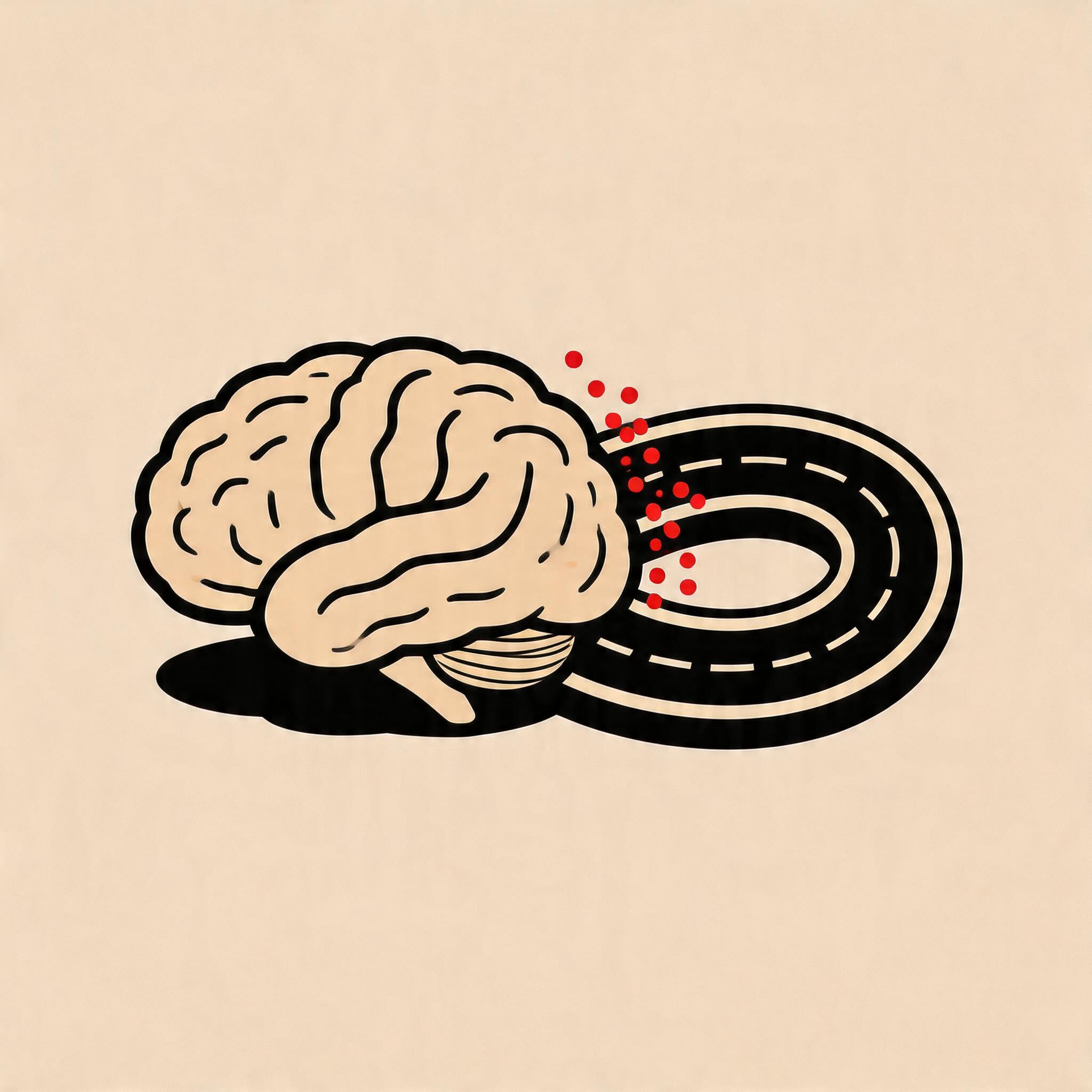
Why do we run when there is no destination? The endless runner genre, popularized by titles like Canabalt and Temple Run, strips gaming down to its most primal psychological components. It is a genre built entirely on the concept of inevitability: you will eventually fail. Yet, players return repeatedly, trapped in a meticulously engineered loop of dopamine and adrenaline.
The Anatomy of Flow State
Mihaly Csikszentmihalyi defined "flow" as a state of complete immersion in an activity. Endless runners are the purest distillation of flow theory in video games. They achieve this by strictly managing cognitive load. The player is typically given only one or two inputs (jump, slide, or swipe). Because the cognitive barrier to entry is practically zero, the brain bypasses analytical thinking and enters a state of pure reactive instinct.
As the game progresses, the speed increases, perfectly scaling the challenge to match the player's increasing acclimatization. This delicate balance prevents both boredom (when the challenge is too low) and anxiety (when the challenge spikes too suddenly).
"The endless runner doesn't test your strategy; it tests the latency between your optic nerve and your motor cortex."
The 'Near-Miss' Effect
One of the most potent psychological hooks in endless runners is the 'near-miss' phenomenon, a concept heavily studied in the psychology of gambling. When a player narrowly avoids an obstacle—perhaps grazing a spike or leaping over a chasm at the very last millisecond—the brain registers this not as a close call, but as a minor victory.
Neurological Reward Systems
This near-miss triggers a release of dopamine identical to what occurs during a major win. The game provides immediate visual and auditory feedback (a specific sound effect, a particle burst) to reinforce this survival. The player is conditioned to seek out these thrilling close calls, inherently increasing the risk and the eventual likelihood of failure.
The Illusion of Progress
Because the physical space of the game is infinite, developers must construct artificial markers of progress. This is achieved through:
- Micro-goals: Collecting coins or tokens that provide immediate, tangible feedback.
- Meso-goals: Completing specific missions during a run (e.g., "slide under 10 barriers").
- Macro-goals: Unlocking new characters, aesthetic upgrades, or permanent power-ups that make subsequent runs slightly easier.
This layered goal structure ensures that even when the primary objective (surviving) ends in failure, the player still feels a sense of accomplishment, mitigating frustration and prompting the immediate press of the "Play Again" button. It's a masterclass in psychological manipulation, transforming inevitable defeat into a compelling reason to continue.