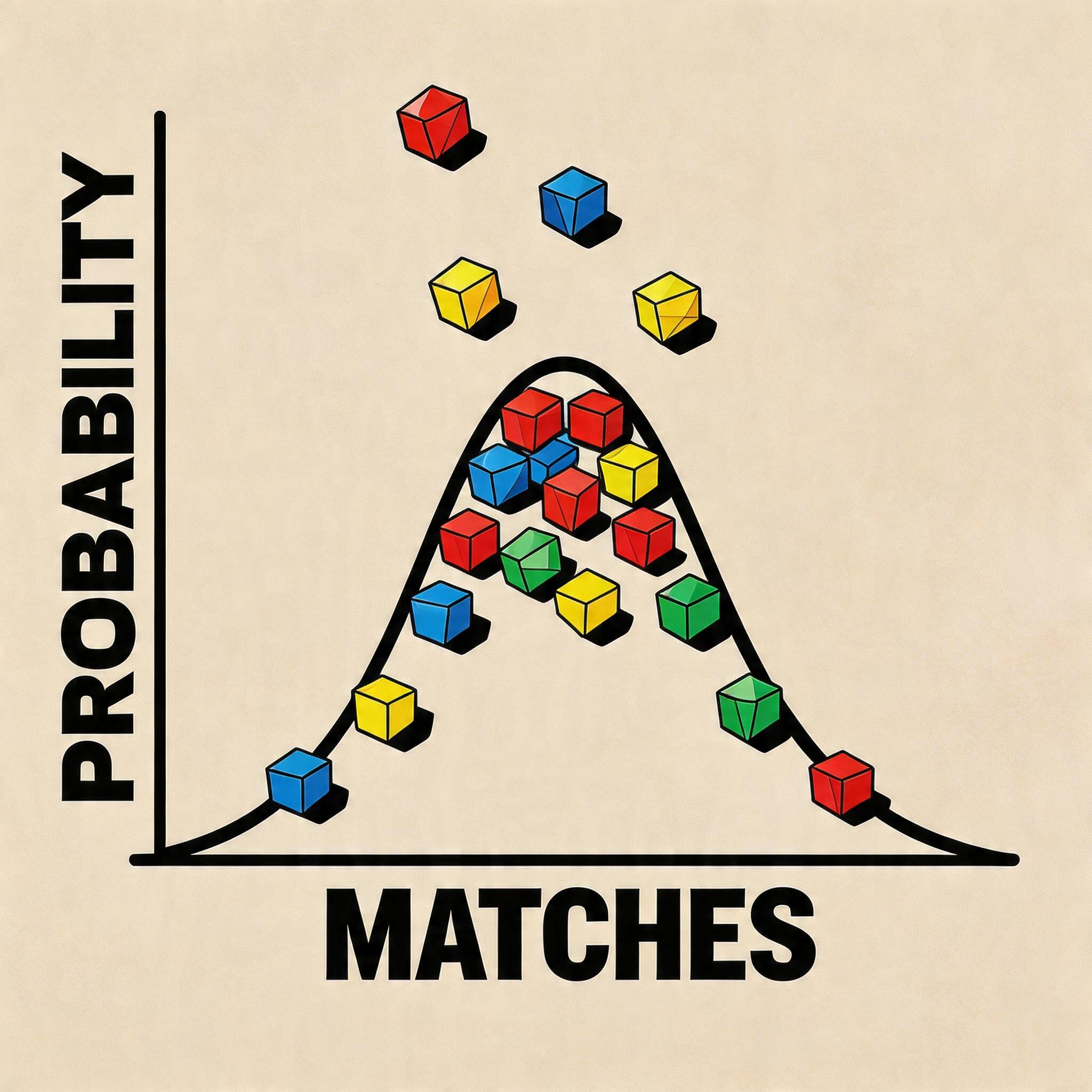
When you align three shimmering gems and watch a cascade of colorful explosions clear the board, it feels like a triumph of pattern recognition and strategic planning. In reality, modern Match-3 games are highly orchestrated engines of probability manipulation. The arrangement of pieces falling from the top of the screen is rarely purely random; it is meticulously calculated to balance frustration with euphoric release.
RNG vs. PRNG: The Illusion of Randomness
True Random Number Generation (RNG) is dangerous in game design. In a truly random system, it is entirely possible to go 50 turns without receiving the specific blue tile you need, leading to immense player frustration and app abandonment. To counter this, developers use Pseudo-Random Number Generators (PRNG) coupled with 'bag' algorithms.
Instead of rolling a die for every new tile, the game acts like it is pulling tiles from a hidden bag containing a set number of each color. Once a blue tile is pulled, the chance of pulling another blue tile slightly decreases, ensuring an eventual, mathematically guaranteed even distribution. This 'smoothed' randomness feels fairer to the human brain than actual statistical randomness.
"If we gave players true mathematical randomness, they would accuse the game of being rigged. We have to rig the game to make it feel fair." — Lead Systems Designer
Drop Weights and Dynamic Difficulty
The probability of specific pieces appearing is often tied to the player's current state. This is managed through dynamic drop weights. If a player is struggling on a level for several days, the game's algorithm might secretly adjust the drop weights in their favor.
The "Lucky Board" Phenomenon
- Pity Timers: An invisible counter that guarantees a highly beneficial cascade or a special power-up piece if the player has failed to make significant progress in the last X moves.
- Near-Win Scenarios: Algorithms specifically designed to leave the player just one or two moves short of victory, triggering the psychological urge to spend premium currency for "just five more moves."
The Mathematics of the Cascade
The most thrilling moment in a Match-3 game is the cascade—when one match causes tiles to fall and trigger a chain reaction of subsequent matches. Calculating these in real-time requires efficient recursive algorithms.
However, even cascades are sometimes pre-calculated. When the board needs to be repopulated, the algorithm can simulate thousands of drops in milliseconds, select a drop sequence that guarantees a massive, satisfying 5-combo cascade, and then visually play that specific sequence out for the player. The player believes they initiated a lucky chain reaction, but the mathematics of the dopamine hit were authored by the server long before the tiles even appeared on screen.